Vatnajökull Glacier
Operation NapoleonVatnajökull Glacier is both a landscape and an obstacle in the novel: a vast field of snow and ice that hides an aircraft, frustrates an extensive search, and decades later yields the wreck to military investigators. Its weather and terrain determine who can reach it and when, while its apparently empty surface becomes a recurring source of uncertainty, discovery, and conflict.
Landscape, Weather, and Access
The glacier is introduced through a blizzard so severe that a man crossing it can see nothing ahead and can barely make out the compass in his hand. Snow lashes his face, cakes his clothes, and forces him to sink to his knees with every step. He has lost his sense of time and cannot tell whether it is day or night; the account reduces his progress to a repeated pattern of a few steps, a rest, and a few more. The storm makes the glacier more than a difficult route: it strips away ordinary measures of direction, time, and endurance.
The same weather governs travel to the glacier from the surrounding settlements. After brothers on a farm witness an aircraft pass south of the ice, they cannot report it immediately because their telephone line is out of order after another storm. They wait four days for conditions to improve before setting out on horseback for Höfn. During the 1945 search, winter daylight lasts only from eleven in the morning until half past five, limiting the hours available on the ice. Storms later bury tents and equipment, helping bring Colonel Miller’s expedition to an end.
The glacier is difficult to approach even for a large military force. Rivers flowing from the ice cap across glacial outwash plains make the south-coast route to Höfn impassable to vehicles, so Miller’s force has to take the northern route around the country. Its convoy digs through deep snowdrifts before turning south through the East Fjords. The brothers’ farm offers a passable route onto the ice, and their knowledge of the area helps the inexperienced soldiers avoid crevasses and gullies. Their guidance leads the force to a camp in a depression at the glacier’s edge, about 1,100 metres above sea level.
The 1945 Crash and Search
The plane’s crash gives the glacier its defining role in the earlier history. After an engine catches fire, one wing shears off and disappears into the snow-filled darkness; the other is torn away in a shower of sparks. The fuselage careens across the ice. The crash leaves some people less fortunate than the man who survives it almost unscathed, but the wreck does not remain accessible on the surface. The storm and the glacier’s snow soon obscure the evidence.
The brothers’ report reaches the authorities only after they make the journey to Höfn. The district official contacts Reykjavík, but the American military headquarters quickly takes over the case, promises a rescue party, and bans traffic on the part of the glacier where the plane is believed to have gone down. No explanation is offered to the locals. The military force sent to Höfn numbers two hundred soldiers in twelve transport vehicles, a considerable undertaking made necessary by the closed airstrip and the blocked route west from the capital.
Colonel Miller leads the search with the brothers’ assistance. His men divide their work between the foothills and the ice cap, combing the slopes and a five-square-kilometre area of the glacier. The brothers’ local experience contrasts with the soldiers’ limited familiarity with winter glacier travel; they guide the force around hazards and help direct the search. Miller consults them often, and the search brings him into friendly relations with the brothers. His determination impresses them: he appears tireless and remains fixed on finding the plane.
The only aircraft fragment found is the rim of the nose wheel, discovered by the brothers about two kilometres onto the ice cap. Miller immediately takes charge of it. Beyond that small piece, the ice is smooth in every direction, with no visible sign that a plane has crashed or made a forced landing. The brothers suggest that snow may already have drifted over the wreck. After severe weather hampers the expedition twice, with tents and equipment lost in the second storm, Miller abandons the search. On his final walk farther out over the ice, fine weather reveals a pristine white expanse, but the apparent calm cannot settle his fear: he believes his brother may still be trapped inside the aircraft beneath him, dying of cold and hunger.
Rediscovery and Military Presence
Decades later, the glacier is surveyed from a different vantage point. Vytautas Carr studies paired satellite images in an intelligence organisation’s control room: an archive image from about a year earlier and a picture taken that day. The older photograph shows an unremarkable white ice cap broken by occasional belts of crevasses. In the newer one, a small mark appears in the lower-left corner. Magnified until it fills the screen, the mark turns the glacier’s blankness into evidence that something has changed. The discovery renews the military interest in an aircraft that the earlier search failed to find.
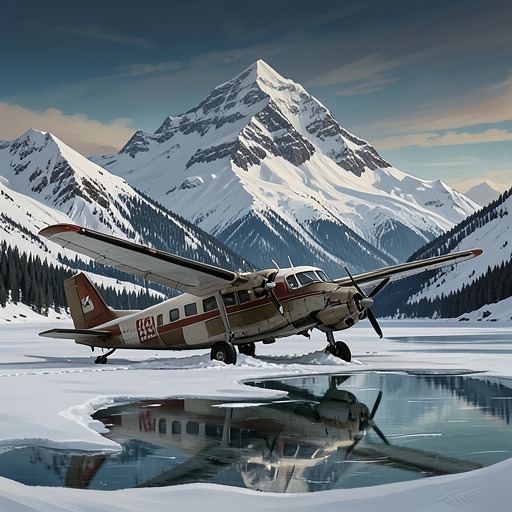
By Friday 29 January, 1900 GMT, a communications tent stands beside the aircraft on Vatnajökull Glacier. The next day, Delta Force operators clear snow from both sides of the wreck. As the light grows, the nose becomes more distinct, jutting upward at an angle of twenty degrees, while the tail remains buried in dense, hard-packed ice. The fuselage appears largely intact, and little snow seems to have entered it. The contrast with the 1945 search is sharp: where Miller found an open, featureless surface and one wheel rim, the later team has exposed a substantial part of the aircraft.
Conflict on the Ice and the Glacier’s Significance
The renewed operation makes the glacier a contested space. Late on Saturday 30 January, Icelandic rescuers wait beside their tracked vehicles after American soldiers stop them, confiscate their communications equipment, and search their people and vehicles for flares, radios, and mobile phones. The soldiers then hold their position, preventing the Icelanders from continuing. Júlíus slips away from the guarded vehicles and crosses the ice in darkness, driven by anger at being searched and stopped in his own country and by concern for Kristín and Elías.
From a rise near the illuminated military site, Júlíus sees two Pave Hawk helicopters, soldiers, tents, and the old plane cut into halves and covered with tarpaulins. He also sees Kristín being taken into a tent, followed by a man marched there under guard. When he reaches the tent, he finds a man facedown with blood on the wall and a hole in the back of his head, and Kristín lying unconscious on the ice. Later, as a helicopter lifts one half of the aircraft on thick steel cables and carries it west into darkness, Júlíus escapes the tent through a cut in its canvas wall. The glacier’s open surface has not prevented secrecy; instead, isolation and military control make the recovery difficult for local witnesses to observe or challenge.
Across these episodes, Vatnajökull Glacier repeatedly conceals and discloses the same history. Snow hides the aircraft from Miller’s painstaking search; a later satellite comparison detects a mark; excavation reveals the wreck piece by piece; and the military operation attempts to remove it from the ice. The glacier’s apparent emptiness therefore remains unstable: it can be a blank expanse, a lethal environment, a burial place, and a scene of confrontation. Its physical power to cover the past is matched by the recurring effort to reach what lies beneath it.